Ready to take your IT career to the next level? The CompTIA Network+ certification is the industry standard for validating the skills of networking professionals. To succeed, you need to master the latest exam objectives. This is our first installment of a new study guide for Network+. We will add a post for each CompTIA main domain and sub-objective.
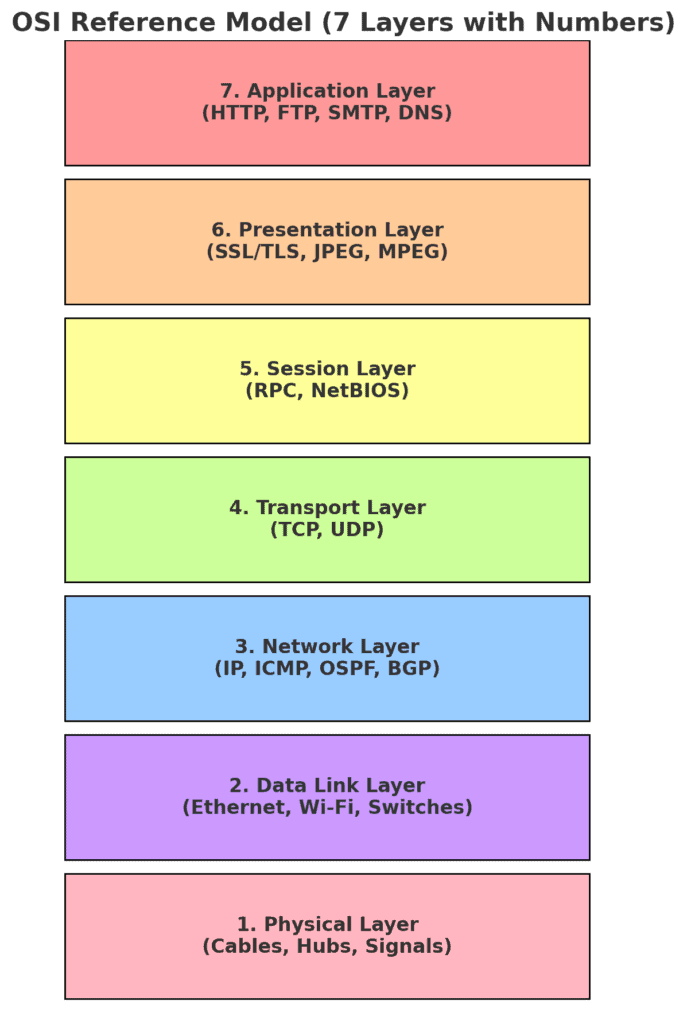
The Open Systems Interconnection (OSI) reference model is one of the most important frameworks in the field of computer networking. It was developed by the International Organization for Standardization (ISO) in 1984 as a conceptual model to standardize the functions of a communication system without being tied to a specific technology. The OSI model divides the networking process into seven distinct layers, each of which performs a well-defined role in the transmission of data across networks. By segmenting the tasks, the model helps engineers, developers, and administrators understand complex interactions, troubleshoot issues, and design interoperable systems.
In this discussion, we will explain the concepts of the OSI model, examine the purpose of each of its seven layers, and highlight its practical importance in networking.
The OSI model was not intended to be implemented exactly as designed; rather, it serves as a guide to understand how networking components work together. Its goals can be summarized as follows:
These skills are typically what you would learn with 9 to 12 months of hands-on experience in a junior network administrator or support technician role. Keep in mind that the examples provided in the study materials are not an exhaustive list of what will be on the test, but they are a great way to start your studying. CompTIA regularly updates its exams to ensure they stay current, and any changes will be reflected in the official study materials.
CompTIA AUTHORIZED MATERIALS USE POLICY
CompTIA Certifications, LLC is not affiliated with and does not authorize, endorse, or condone utilizing any
content provided by unauthorized third-party training sites (aka “brain dumps”). Individuals who utilize
such materials in preparation for any CompTIA examination will have their certifications revoked and be
suspended from future testing in accordance with the CompTIA Candidate Agreement. In an effort to more
clearly communicate CompTIA’s exam policies on use of unauthorized study materials, CompTIA directs
all certification candidates to the CompTIA Certification Exam Policies. Please review all CompTIA policies
before beginning the study process for any CompTIA exam. Candidates will be required to abide by the
CompTIA Candidate Agreement. If a candidate has a question as to whether study materials are considered
unauthorized (aka “brain dumps”), he/she should contact CompTIA at [email protected] to confirm.
PLEASE NOTE
The lists of examples provided in bulleted format are not exhaustive lists. Other examples of
technologies, processes, or tasks pertaining to each objective may also be included on the exam
although not listed or covered in this objectives document. CompTIA is constantly reviewing the
content of our exams and updating test questions to be sure our exams are current, and the security
of the questions is protected. When necessary, we will publish updated exams based on existing
exam objectives. Please know that all related exam preparation materials will still be valid.
By continuing to browse this site, you accept the use of cookies and similar technologies that will allow the use of your data by CertBlaster in order to produce audience statistics- see our privacy policy.